
NCT 펀칭 vs 파이버 레이저, 생산 수량별 어느 공정이 경제적인가?
NCT와 파이버 레이저는 수량보다 부품의 성격으로 선택합니다
두 공정을 나누는 고정된 수량선은 없습니다. 같은 수량이라도 반복 홀, 외곽 형상, 성형과 탭, 요구 품질에 따라 결과가 달라집니다.
NCT는 펀치와 다이로 판재를 전단하므로 규칙적인 홀과 슬롯을 반복할 때 강합니다. 파이버 레이저는 전용 외곽 공구 없이 프로그램을 바꿀 수 있어 자유곡선과 설계 변경에 유연합니다.
비교 기준은 절단이 끝난 평판이 아니라 납품 가능한 완성품입니다. 디버링, 성형, 탭, 세척, 검사와 공정 이동까지 같은 범위로 맞춰야 실제 단가와 리드타임을 판단할 수 있습니다.
부서별 역할도 처음부터 정리해야 합니다. 구매 담당자는 견적 범위를 맞추고, 설계 담당자는 기능과 변경 가능성을 알리며, 생산기술 담당자는 가공 순서와 품질 위험을 확인합니다.
공정은 제조사가 보유한 장비와 공구까지 확인한 뒤 정하는 편이 효율적입니다. 같은 도면도 자동화 구성과 표준 공구 보유 여부에 따라 더 단순한 생산 경로를 선택할 수 있습니다.
- 소재, 두께, 수량과 납품 상태를 같은 조건으로 맞춥니다.
- 외관면, 버 방향, 성형과 탭의 필요 여부를 먼저 확인합니다.
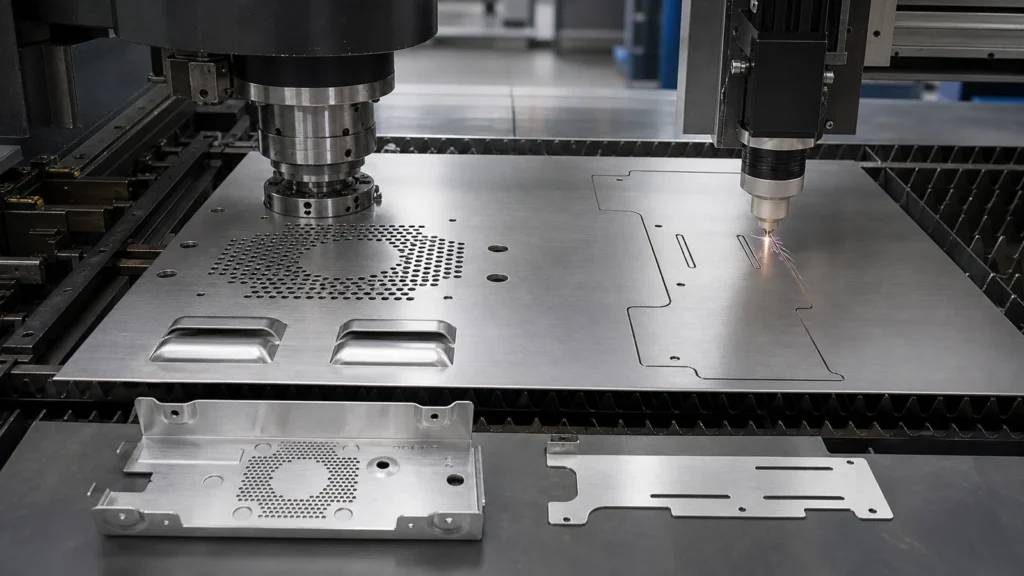
NCT 펀칭과 파이버 레이저의 비용 구조
NCT의 비용은 최대 타격 속도보다 공구 구성과 반복성에 더 크게 영향을 받습니다. 보유한 표준 공구에 홀과 슬롯이 잘 맞고 배열이 규칙적이면 짧은 전단 동작으로 생산성을 높일 수 있습니다.
NCT의 숨은 장점은 여러 기능을 한 셋업에 묶을 수 있다는 점입니다. 루버, 엠보싱, 압출 홀, 마킹과 탭을 함께 처리하면 별도 프레스와 탭 장비로 옮기는 시간과 재검사를 줄일 수 있습니다.
파이버 레이저의 비용은 피어싱과 전체 절단 경로에서 결정됩니다. 자유곡선과 다양한 외곽은 유연하게 처리하지만 작은 홀과 슬롯이 많으면 피어싱과 짧은 이동이 반복되어 시간이 누적됩니다.
두 공정의 공통 비용은 재료 수율과 후공정입니다. 같은 시트 규격과 결 방향으로 시트당 합격품 수를 비교하고, 보조가스, 드로스 제거, 디버링과 부품 취출까지 포함해야 합니다.
공정 사이의 이동도 비용과 납기를 늘리는 요인입니다. 절단 속도가 조금 느려도 성형과 탭을 흡수하면 완성품 리드타임이 짧아질 수 있으며, 복잡한 외곽을 한 번에 끝내면 별도 연마를 줄일 수 있습니다.
- NCT는 표준 공구, 특수 공구와 성형 통합 범위를 확인합니다.
- 레이저는 피어싱 수, 절단 경로와 보조가스 범위를 확인합니다.
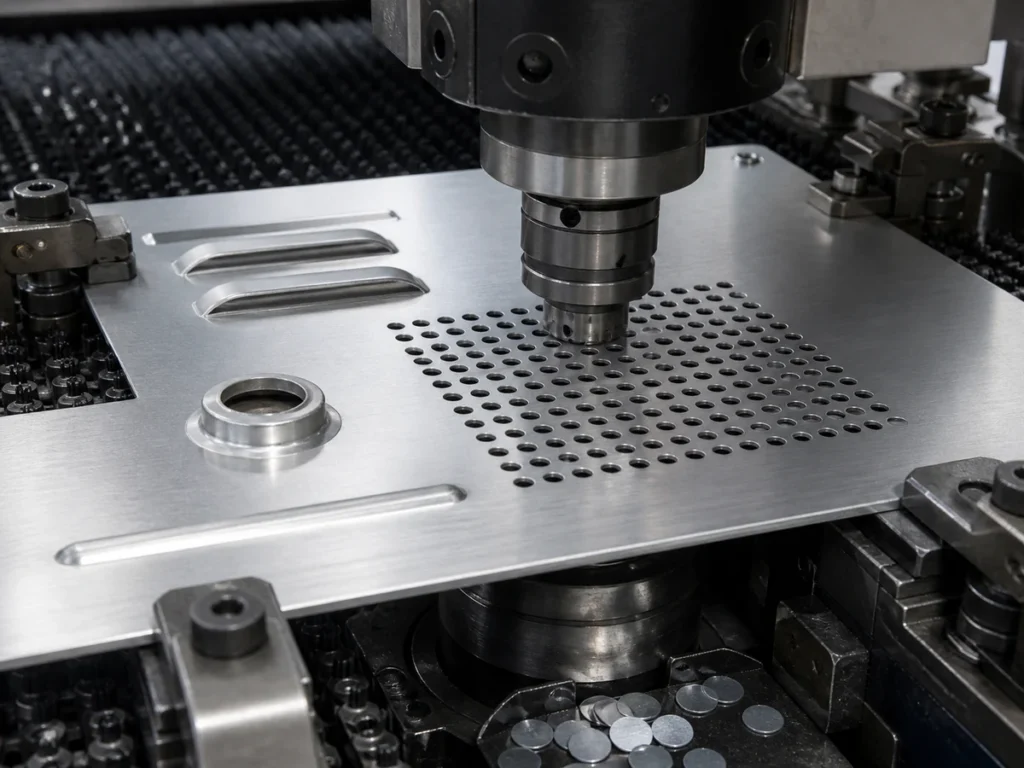
손익분기 수량을 판단하는 실무 방법
손익분기는 가상의 한 수량보다 실제 발주 구간으로 확인하는 편이 정확합니다. 시제품, 승인용 선행 생산, 정규 반복 발주를 같은 도면과 납품 조건으로 각각 견적받아야 합니다.
NCT는 초기 공구와 셋업 부담을 반복 생산에 나누어 반영할 수 있습니다. 레이저는 전용 외곽 공구 없이 변경에 빠르게 대응하지만 절단과 가스 비용이 발주마다 다시 반영됩니다.
실질 단가는 투입품이 아니라 합격품 기준으로 비교해야 합니다. 버, 드로스, 평탄도와 외관 손상으로 재작업이 생기면 낮아 보였던 단가와 납기가 달라집니다.
설계 변경 가능성도 비용으로 보아야 합니다. 초기에는 레이저로 형상을 검증하고 설계가 안정된 뒤 NCT로 전환하면 공구 투자와 변경 위험을 함께 관리할 수 있습니다.
발주 방식도 손익분기에 영향을 줍니다. 같은 총수량이라도 한 번에 생산하는 경우와 분할 납품하는 경우에는 재셋업, 검사와 포장 횟수가 달라지므로 견적 조건에 발주 주기를 밝혀야 합니다.
- 초도 수량, 반복 발주량, 연간 예상 수량을 함께 제시합니다.
- 재작업, 폐기와 설계 변경을 포함한 완성품 기준으로 비교합니다.
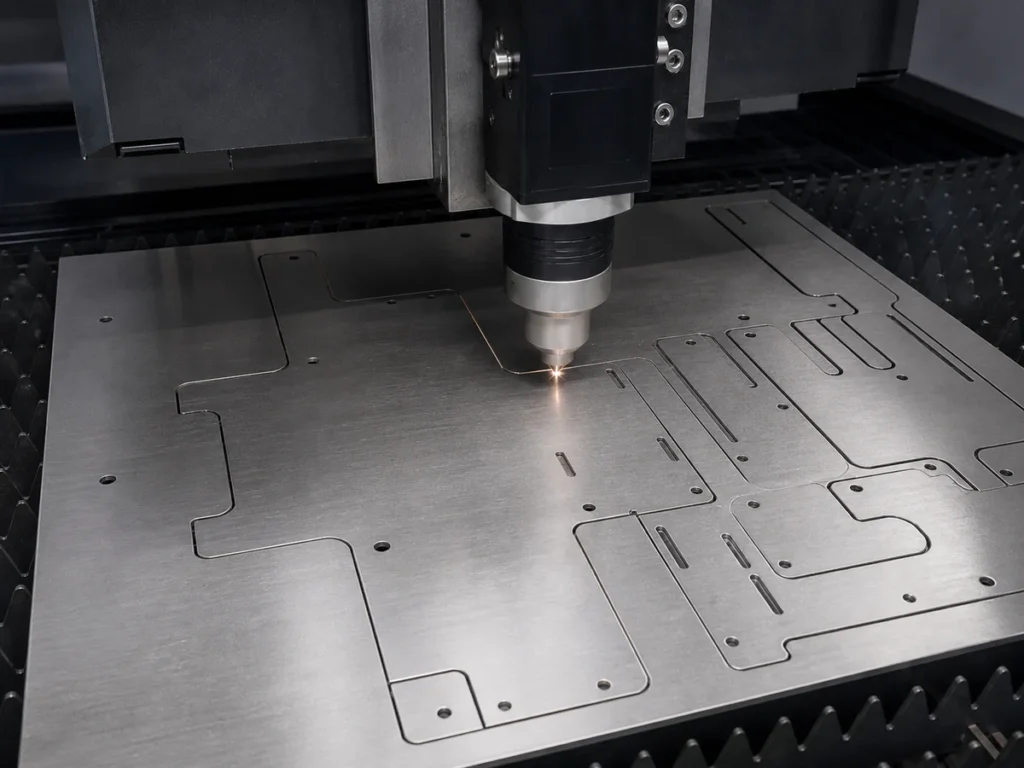
형상에 따라 공정을 선택하는 기준
반복 통풍 홀과 표준 슬롯이 많으면 NCT를 먼저 검토합니다. 서버랙과 제어반처럼 홀 배열이 규칙적이면 표준 공구를 효율적으로 사용할 수 있으며, 클러스터 공구가 맞으면 여러 홀을 한 번에 가공할 수 있습니다.
성형과 탭이 함께 있는 부품도 NCT에 적합할 수 있습니다. 루버, 엠보싱, 압출 홀을 같은 셋업에서 처리하면 위치 관계를 관리하기 쉽지만, 밀집 타공과 높은 성형은 판재 휨과 공구 간섭을 확인해야 합니다.
자유곡선과 잦은 변경이 중심이면 파이버 레이저를 먼저 검토합니다. 비정형 창과 제품별로 다른 외곽은 프로그램으로 수정할 수 있어 시제품과 여러 리비전에 빠르게 대응할 수 있습니다.
두 특성이 섞인 부품은 혼합 공정이 더 합리적일 수 있습니다. NCT로 반복 홀과 성형을 처리하고 레이저로 외곽을 완성할 때는 재클램핑 기준과 공정 간 위치 오차를 관리해야 합니다.
형상은 면적보다 가공 동작으로 나누어 보는 편이 정확합니다. 반복 홀, 성형, 외곽과 작은 코너를 기능별로 표시하면 제조사가 단독 공정과 혼합 공정을 더 빠르게 비교할 수 있습니다.
- 반복 홀은 공구 적합성, 홀 피치와 타공 뒤 평탄도를 확인합니다.
- 자유곡선과 혼합 형상은 변경 빈도, 셋업 수와 위치 기준을 확인합니다.
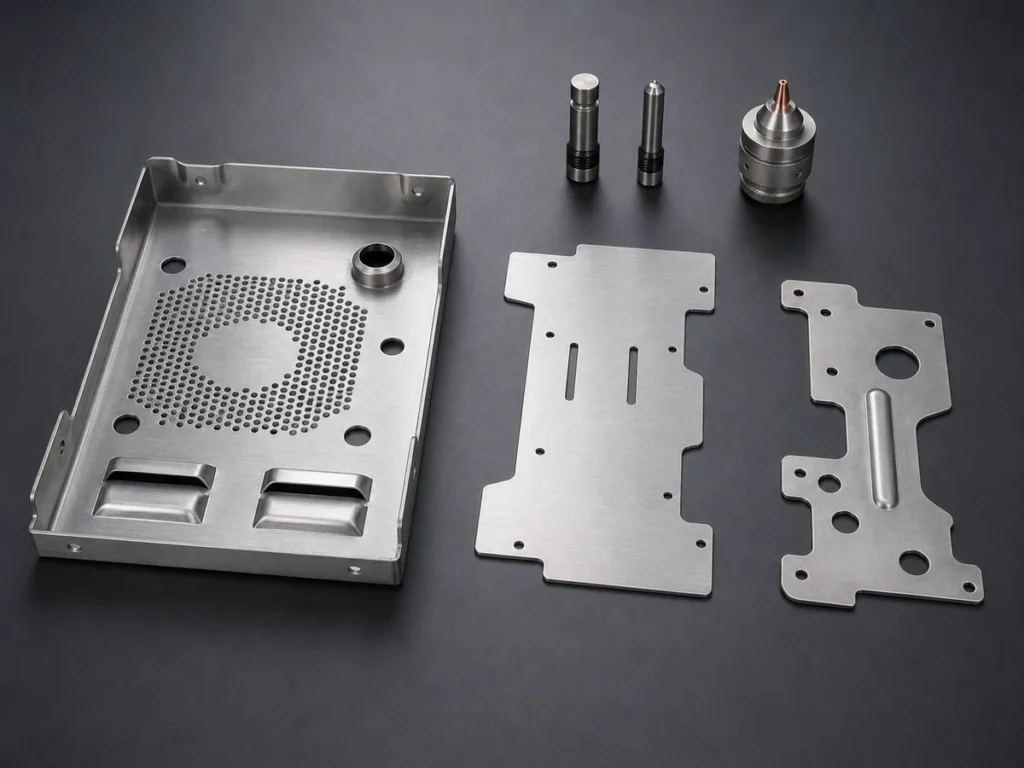
소재와 판 두께, 품질이 공정 선택을 바꾸는 방식
NCT는 소재가 두껍고 강할수록 전단 하중과 공구 마모가 커집니다. 펀치와 다이의 간극이 소재와 두께에 맞지 않으면 버가 커지고 절단면 편차가 늘어날 수 있습니다.
파이버 레이저는 소재의 열 반응, 표면 상태와 보조가스에 따라 품질이 달라집니다. 질소와 산소의 선택은 절단면 산화와 후속 용접, 도장 준비에 영향을 주므로 완성품 조건으로 결정해야 합니다.
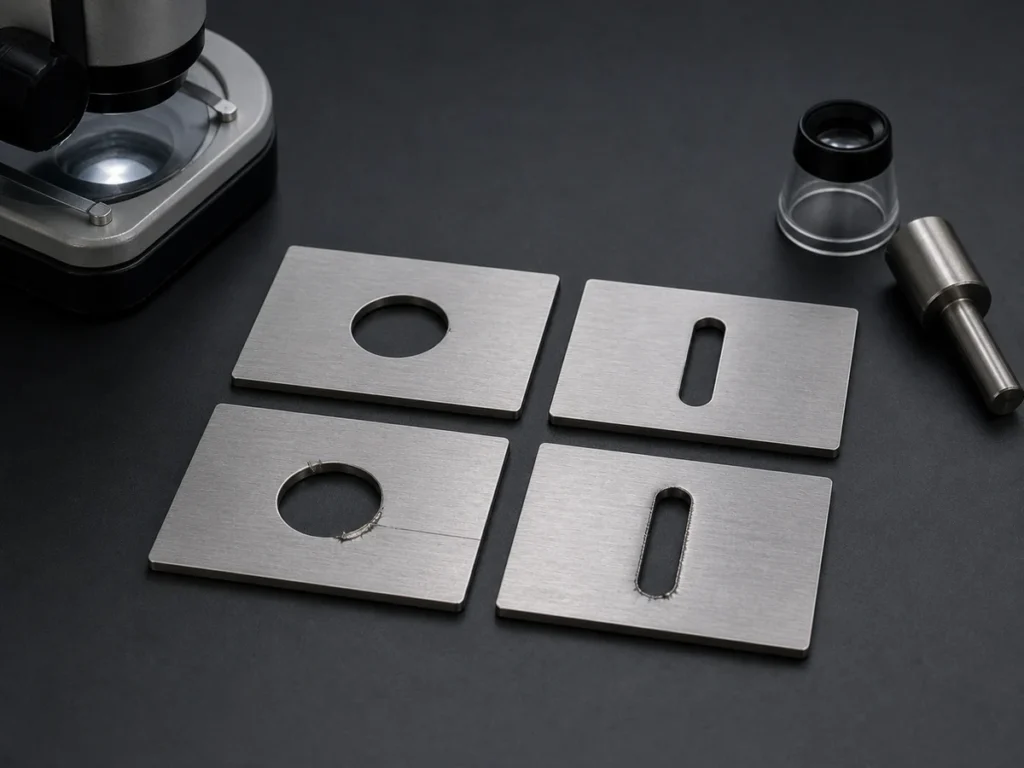
NCT 품질은 출구 버와 전단면, 밀집 타공 뒤 평탄도를 함께 봅니다. 레이저 품질은 하부 드로스, 피어싱 흔적, 절단면 산화와 열 영향을 함께 봅니다.
비접촉 절단도 외관면 손상에서 자유롭지는 않습니다. 레이저 슬랫과 부품 취출, NCT 다이와 테이블 이동 과정에서 스크래치가 생길 수 있으므로 보호필름과 적재 방법을 확인해야 합니다.
도면에는 공정명보다 기능 요구를 적는 편이 정확합니다. 케이블 통과부, 가스켓 밀착면, 작업자 접촉부와 조립 기준면을 구분하면 필요한 검사와 후처리에 집중할 수 있습니다.
작은 홀과 좁은 슬롯은 가공 가능 여부와 양산 안정성을 구분해야 합니다. 실제 소재로 초도품을 만들고 원형도, 절단면, 버와 조립성을 확인하면 반복 생산의 재작업을 줄일 수 있습니다.
초도품의 합격 기준은 양산 검사에도 그대로 이어져야 합니다. 검사 기준이 바뀌면 발주 시점과 공급사별 결과를 정확하게 비교하기 어렵습니다.
- 기능 모서리의 버 방향과 외관면의 허용 상태를 정합니다.
- 평탄도, 조립 기준면과 초도품 검사 방법을 정합니다.
에너지와 탄소를 비교하는 올바른 범위
환경성은 장비의 순간 전력보다 합격품 전체 경로로 비교해야 합니다. 전력이 높은 장비가 짧게 가공할 수 있고, 전력이 낮은 장비도 긴 대기와 재작업으로 사용량이 늘어날 수 있습니다.
보조 설비와 후공정도 같은 범위에 포함해야 합니다. NCT는 축 이동과 압축공기, 로딩을 포함하고 레이저는 칠러와 집진, 보조가스와 언로딩을 포함합니다.
재료 수율은 에너지와 탄소 결과를 크게 바꿀 수 있습니다. 시트당 합격품이 적거나 외관 불량을 폐기하면 소재 생산에 들어간 부담도 함께 낭비됩니다.
현장에서는 복잡한 계산보다 동일한 항목을 꾸준히 기록하는 일이 먼저입니다. 작업별 가공시간, 합격품 수, 스크랩과 재작업을 남기면 공정 개선과 다음 견적에 활용할 수 있습니다.
환경 자료는 산정 범위를 함께 보아야 의미가 있습니다. 장비 본체 전력만 제시한 값과 보조 설비, 후공정, 스크랩까지 포함한 값은 직접 비교할 수 없으므로 실제 측정 항목을 확인해야 합니다.
- 셋업, 가공, 대기와 후공정 시간을 같은 범위로 기록합니다.
- 시트 수, 합격품 수, 스크랩 중량과 재작업 원인을 기록합니다.
대표 사례와 정확한 비교 견적을 위한 RFQ
대표 부품은 형상과 후공정으로 빠르게 구분할 수 있습니다. 절단 장비의 이름보다 완성품까지 필요한 작업을 먼저 놓으면 선택 이유가 명확해집니다.
- 서버 패널은 반복 통풍 홀, 루버 방향과 타공 뒤 평탄도를 확인합니다.
- 스테인리스 시제품 함체는 자유곡선, 변경 빈도와 보호필름을 확인합니다.
- 혼합 브래킷은 표준 홀, 성형, 자유곡선과 재클램핑 기준을 확인합니다.
정확한 견적은 도면과 완성품 조건을 함께 제공할 때 나옵니다. 구매, 설계, 생산기술 부서가 아래 정보를 한 번에 정리하면 반복 질의와 견적 수정이 줄어듭니다.
- 도면 번호, 리비전과 설계 동결 시점을 제공합니다.
- 소재 규격, 판 두께와 표면 상태를 제공합니다.
- 초도 수량, 반복 발주량과 연간 수량을 제공합니다.
- 외관면, 결 방향과 보호필름 조건을 제공합니다.
- 버 방향, 평탄도와 기능 기준면을 제공합니다.
- 성형, 탭, 디버링과 세척 범위를 제공합니다.
- 초도검사, 성적서와 추적성 범위를 제공합니다.
- 포장 방식, 납기와 분할 납품 조건을 제공합니다.
최종 비교표에는 재료 수율, 셋업, 가공과 후공정, 검사, 합격률과 납기를 나란히 놓아야 합니다. 동일한 완성품 범위에서 비교하면 고정된 수량선보다 신뢰할 수 있는 결론을 얻을 수 있습니다.
견적의 주요 근거는 다음 발주를 위해 남겨 두는 편이 좋습니다. 시트당 합격품 수, 공구 구성, 후공정과 초도검사 항목을 기록하면 리비전이나 공급사가 바뀌어도 같은 기준으로 다시 비교할 수 있습니다.
관련 실무 내용은 NCT 공정 원리, NCT 공차·후처리, NCT 성형에서 확인할 수 있습니다. 제작 범위는 NCT·파이버 레이저 판금 가공 서비스에서 살펴볼 수 있으며, 도면 검토는 문의를 이용할 수 있습니다.
English Technical Overview
Select NCT or fiber laser cutting by the part’s characteristics, not quantity alone
There is no fixed quantity threshold that separates the two processes. Even at the same quantity, the result changes with repeated holes, outer geometry, forming and tapping, and the required quality.
NCT shears sheet material with a punch and die, making it strong for repeated, regular holes and slots. Fiber laser cutting can change programs without a dedicated outer-profile tool, providing flexibility for free-form curves and design revisions.
The basis for comparison is not the flat blank after cutting, but the finished part ready for delivery. Deburring, forming, tapping, cleaning, inspection, and process transfers must be aligned within the same scope to assess the real unit price and lead time.
The responsibilities of each function should also be established from the beginning. Purchasing aligns the quotation scope, design engineering communicates function and the likelihood of change, and production engineering verifies the processing sequence and quality risks.
It is efficient to select the process after confirming the manufacturer’s available equipment and tooling. Depending on the automation configuration and availability of standard tools, a simpler production route may be possible even for the same drawing.
- Align material, thickness, quantity, and delivered condition under the same requirements.
- First confirm appearance surfaces, burr direction, and whether forming and tapping are required.
Cost Structures of NCT Punching and Fiber Laser Cutting
NCT cost is influenced more by tooling configuration and repeatability than by maximum punching speed. When holes and slots match the available standard tools and their arrangement is regular, productivity can be increased through short shearing actions.
A less visible advantage of NCT is the ability to combine several functions in one setup. Processing louvers, embosses, extruded holes, marking, and tapping together can reduce transfers to separate presses and tapping equipment, as well as repeated inspection.
Fiber laser cost is determined by piercing and the total cutting path. It handles free-form curves and diverse outer profiles flexibly, but numerous small holes and slots cause repeated piercing and short movements that accumulate processing time.
Material yield and downstream operations are shared costs of both processes. Accepted parts per sheet should be compared using the same sheet size and grain direction, with assist gas, dross removal, deburring, and part removal all included.
Transfers between processes also increase cost and lead time. Even if cutting is slightly slower, absorbing forming and tapping can shorten finished-part lead time, while completing a complex outer profile in one operation can reduce separate grinding.
- For NCT, confirm standard tools, special tools, and the scope of integrated forming.
- For laser cutting, confirm the number of piercings, cutting path, and assist-gas scope.
A Practical Method for Determining Break-Even Quantity
Break-even quantity is assessed more accurately by actual purchasing ranges than by one hypothetical quantity. Prototypes, pre-approval pilot production, and regular repeat orders should each be quoted using the same drawing and delivered conditions.
NCT can spread its initial tooling and setup burden across repeat production. Laser cutting responds quickly to changes without a dedicated outer-profile tool, but cutting and gas costs recur with every order.
Real unit price should be compared on the basis of accepted parts, not input pieces. Rework caused by burrs, dross, flatness, or appearance damage changes the unit price and lead time that initially appeared lower.
The likelihood of design change must also be treated as a cost. Using laser cutting to verify the geometry at the beginning and switching to NCT after the design stabilizes can manage tooling investment and change risk together.
The purchasing method also affects break-even quantity. Even for the same total quantity, one production run and split deliveries involve different numbers of setups, inspections, and packaging operations, so the order frequency should be stated in the quotation requirements.
- Provide the first-article quantity, repeat order quantity, and expected annual quantity together.
- Compare on a finished-part basis that includes rework, scrap, and design changes.
Criteria for Selecting a Process by Geometry
When a part contains numerous repeated ventilation holes and standard slots, review NCT first. Regular hole arrays, such as those on server racks and control panels, allow standard tools to be used efficiently, while a suitable cluster tool can produce several holes at once.
Parts that combine forming and tapping may also suit NCT. Processing louvers, embosses, and extruded holes in the same setup makes positional relationships easier to control, but dense punching and tall forms require checks for sheet distortion and tool interference.
When free-form curves and frequent revisions dominate, review fiber laser cutting first. Irregular windows and product-specific outer profiles can be revised by program, enabling a rapid response to prototypes and multiple revisions.
A mixed process may be more reasonable for a part that combines both characteristics. When NCT produces repeated holes and formed features and laser cutting completes the outer profile, reclamping datums and inter-process positional error must be controlled.
Geometry is assessed more accurately by processing action than by area. Marking repeated holes, formed features, outer profiles, and small corners by function allows the manufacturer to compare stand-alone and mixed processes more quickly.
- For repeated holes, confirm tool suitability, hole pitch, and flatness after punching.
- For free-form curves and mixed geometry, confirm revision frequency, setup count, and positional datums.
How Material, Sheet Thickness, and Quality Change the Process Choice
In NCT, shearing load and tool wear increase as the material becomes thicker and stronger. If the clearance between punch and die does not suit the material and thickness, burrs can increase and cut-edge variation can become greater.
Fiber laser quality varies with the material’s thermal response, surface condition, and assist gas. The choice between nitrogen and oxygen affects cut-edge oxidation and preparation for subsequent welding and painting, so it should be determined from the finished-part requirements.
NCT quality is assessed through the exit-side burr, sheared edge, and flatness after dense punching. Laser quality is assessed through bottom dross, piercing marks, cut-edge oxidation, and thermal effects.
Noncontact cutting is not free from damage to appearance surfaces. Scratches can occur from laser slats and part removal, or as an NCT sheet travels over dies and tables, so protective film and stacking methods should be confirmed.
It is more accurate to specify functional requirements on the drawing than a process name. Distinguishing cable passages, gasket seating surfaces, operator-contact areas, and assembly datums allows inspection and finishing to focus where they are required.
For small holes and narrow slots, process feasibility must be distinguished from production stability. Producing a first article in the actual material and checking roundness, cut edges, burrs, and assembly fit can reduce rework during repeat production.
The first-article acceptance criteria should carry forward unchanged into production inspection. If inspection criteria change, results from different ordering points and suppliers become difficult to compare accurately.
- Define burr direction at functional edges and the allowable condition of appearance surfaces.
- Define flatness, assembly datums, and the first-article inspection method.
The Right Scope for Comparing Energy and Carbon
Environmental performance should be compared across the complete route to an accepted part rather than by the machine’s instantaneous power draw. A machine with a higher power draw may process the part quickly, while one with a lower power draw may still consume more energy because of long idle periods and rework.
Auxiliary equipment and downstream operations must be included within the same scope. NCT includes axis movement, compressed air, and loading, while laser cutting includes the chiller, dust collection, assist gas, and unloading.
Material yield can substantially change energy and carbon results. When fewer accepted parts are produced per sheet or parts are discarded because of appearance defects, the burden of producing the material is also wasted.
On the production floor, consistently recording the same items comes before complex calculations. Recording processing time, accepted-part quantity, scrap, and rework for each job supports both process improvement and the next quotation.
Environmental data are meaningful only when reviewed together with the calculation boundary. A figure based only on the machine’s own power consumption cannot be compared directly with one that includes auxiliary equipment, downstream operations, and scrap, so the items actually measured must be confirmed.
- Record setup, processing, idle, and downstream-operation time within the same scope.
- Record the number of sheets, accepted-part quantity, scrap weight, and causes of rework.
Representative Cases and an RFQ for an Accurate Comparative Quotation
Representative parts can be classified quickly by geometry and downstream operations. The rationale for process selection becomes clearer when the operations required to produce the finished part are considered before the machine type.
- For server panels, confirm repeated ventilation holes, louver direction, and flatness after punching.
- For stainless steel prototype enclosures, confirm free-form curves, revision frequency, and protective film.
- For mixed-geometry brackets, confirm standard holes, formed features, free-form curves, and reclamping criteria.
An accurate quotation requires both the drawing and the finished-part requirements. When purchasing, design engineering, and production engineering compile the following information in one package, repeated clarification requests and quotation revisions are reduced.
- Provide the drawing number, revision, and design-freeze point.
- Provide the material specification, sheet thickness, and surface condition.
- Provide the initial order quantity, repeat order quantity, and annual quantity.
- Provide cosmetic surfaces, grain direction, and protective-film conditions.
- Provide burr direction, flatness, and functional datums.
- Provide the scope of forming, tapping, deburring, and cleaning.
- Provide the scope of first-article inspection, inspection reports, and traceability.
- Provide the packaging method, lead time, and split-delivery conditions.
The final comparison table should place material yield, setup, processing and downstream operations, inspection, acceptance rate, and lead time side by side. Comparing the same finished-part scope produces a more reliable conclusion than a fixed quantity threshold.
It is advisable to retain the main basis of the quotation for the next order. Recording accepted parts per sheet, tooling configuration, downstream operations, and first-article inspection items allows the same criteria to be used again even if the revision or supplier changes.
For related practical guidance, see NCT Process Principles, NCT Tolerances and Post-Processing, and NCT Forming. The available production scope is described on the NCT and Fiber Laser Sheet Metal Processing Services page, and drawing reviews can be requested through Contact Us.
추가 정보
NCT 펀칭과 파이버 레이저 경제성 요약
NCT 터렛펀칭과 파이버 레이저의 경제성은 생산 수량 하나만으로 결정되지 않습니다. NCT는 표준 공구로 반복 홀을 빠르게 가공하거나 루버·엠보싱·탭 같은 형상을 한 공정에 통합할 때 유리해질 수 있습니다. 파이버 레이저는 별도의 펀칭 금형 없이 복잡한 외곽과 다양한 형상을 절단할 수 있어 시제품과 설계 변경이 잦은 품목에서 우선 검토됩니다.
정확한 비교에는 셋업비, 특수 공구비, 타격 수 또는 절단 길이, 피어싱 횟수, 재료 네스팅 수율, 디버링·성형·탭 등 후공정 비용이 모두 포함되어야 합니다. 같은 도면과 완성 조건을 기준으로 총비용을 비교하고 로트 수량과 연간 반복 발주량을 함께 제시하는 것이 중요합니다.
핵심 포인트
- 모든 부품에 적용되는 보편적 손익분기 수량은 없습니다.
- 반복 원형·사각 홀과 고밀도 통풍 패턴은 NCT의 타격 생산성을 활용하기 좋습니다.
- 복잡한 자유곡선과 잦은 설계 변경은 파이버 레이저를 먼저 검토할 수 있습니다.
- 루버·엠보싱·익스트루전·탭을 NCT에서 통합하면 별도 후공정 비용을 줄일 수 있습니다.
- NCT의 버·공구 마모와 레이저의 드로스·열영향을 완성품 기준으로 비교해야 합니다.
- 견적에는 소재·두께·공차·외관면·성형·후처리 요구와 연간 수량을 함께 전달해야 합니다.
FAQ
몇 개부터 NCT 펀칭이 파이버 레이저보다 저렴한가요?
고정 수량은 없습니다. NCT의 셋업·공구비와 타격 비용, 레이저의 프로그래밍·피어싱·절단 시간 및 후공정 비용을 같은 범위로 맞춘 뒤 손익분기 수량을 계산해야 합니다.
소량 시제품은 항상 파이버 레이저가 유리한가요?
전용 공구가 필요 없고 설계 변경이 잦다면 유리한 경우가 많습니다. 다만 표준 펀치로 반복 홀을 빠르게 만들거나 성형·탭을 함께 처리할 수 있다면 소량에서도 NCT의 완성품 비용이 낮아질 수 있습니다.
반복 홀이 많으면 NCT가 유리한 이유는 무엇인가요?
준비된 표준 공구가 한 번의 타격으로 홀을 만들기 때문에 같은 형상을 반복할수록 홀당 가공 시간이 짧아질 수 있습니다. 공구 교환, 시트 이동과 리포지셔닝까지 포함해 확인해야 합니다.
NCT 특수 공구비는 어떻게 비교해야 하나요?
초기 제작비뿐 아니라 예상 총생산수량, 재연마와 마모 관리, 설계 변경 시 재사용 가능성을 함께 봐야 합니다. 특수 공구비를 전체 예상 생산량으로 나누어 개당 비용에 반영합니다.
NCT와 파이버 레이저 중 어느 쪽의 품질이 더 좋은가요?
일률적인 우열은 없습니다. NCT는 버·전단면·공구 마모·평탄도를, 레이저는 드로스·절단면·열영향·미세 형상을 확인하고 요구 공차와 외관을 만족하는지 판단합니다.
정확한 비교 견적을 받으려면 어떤 정보를 보내야 하나요?
DXF 또는 전개 데이터, STEP·2D 도면, 소재와 두께, 1회 로트와 연간 수량, 공차, 외관면·버 방향, 루버·엠보싱·탭·절곡, 표면처리와 검사 요구를 함께 전달해야 합니다.
관련 주제 확장 설명
반복 형상과 공구 상각
표준 또는 클러스터 공구를 재사용할 수 있으면 NCT의 고정비 부담이 낮아집니다. 특수 공구라면 제작·보관·재연마·설계 변경 가능성을 예상 총생산량에 나누어 반영해야 합니다.
자유곡선과 리비전 안정성
파이버 레이저는 전용 절단 금형 없이 프로그램을 바꿀 수 있어 복잡한 외곽과 잦은 리비전에 유연합니다. 다만 피어싱 수, 절단 길이, 보조가스와 엣지 후처리를 함께 계산해야 합니다.
완성품 기준의 비교
비교 대상은 절단 직후의 반제품이 아니라 동일한 버·외관·성형·탭·표면처리·검사 조건을 만족한 합격품이어야 합니다. 이 기준이 맞아야 손익분기 계산도 유효합니다.
내부 링크
NCT 터렛펀칭 공정과 품질 변수 · NCT 터렛펀칭 공차 설계 기준 · NCT 성형 가공
NCT 정밀 판금 가공 서비스 · 도면과 예상 수량으로 판금 견적 요청